I recently did a workshop for the City of Moreton Bay Council called ‘Stop Random Acts of Marketing’.
There were lots of nodding heads in the audience as I spelled out a similar scenario, being played out at businesses all over the country…
Business is busy, the phone never seems to spot ringing and orders are pouring in.
Then, without warning, it stops.
A little mild panic sets in amongst business owners. What shall we do next?
“Let’s run some flyers.”
“Let’s send out some emails.”
“Let’s jump on the phones.”
It’s all very reactionary and to be honest, all of us have been guilty of this from one time to another in our businesses.
Random marketing often looks like progress
A social media post goes out. New brochures are printed. Someone sponsors a local event. A video is commissioned. The website gets a new banner across the top.
There is plenty of movement, but movement and direction are not the same thing.
When businesses start with marketing activities instead of strategy, they tend to create disconnected pieces that compete for attention, budget and time. The logo might be consistent, but the thinking behind the marketing is not.
Effective marketing starts much earlier. It begins by deciding exactly who you want to reach, understanding the problem they are trying to solve and explaining clearly why your business is the right choice to help them.
Only then should you decide whether you need a website, brochure, campaign, sign, video or branded coffee mug.
The mug can wait.
Start With a Specific Target Market
One of the quickest ways to weaken your marketing is to aim it at everyone.
“We work with all businesses” may be technically true, but it is rarely useful as a marketing position. A message broad enough to include everyone usually feels relevant to no one.
Different customers have different priorities.
A mining company may be looking for a supplier that can meet strict safety requirements, deliver consistently across remote locations and produce large quantities without sacrificing quality.
A growing hospitality business may need a recognisable identity across its venue signage, menus, uniforms and digital presence.
A professional services firm preparing to pursue larger contracts may need to look more established, explain its expertise clearly and build confidence before the first meeting takes place.
All three may need design, print or signage, but they do not need the same message.
Choosing a target market does not mean refusing to work with anyone outside it. It means making your marketing more relevant to the people you most want to attract.
Once you know who you are speaking to, the problems you discuss, the language you use, the services you lead with and the proof you provide all become much clearer.
Understand the Problem Behind the Purchase
Customers do not usually wake up wanting a new capability statement, vehicle wrap or website.
They want the result those things can help create.
They may want to appear credible when approaching a major client. They may need staff and visitors to navigate a worksite safely. They may be losing enquiries because their website is unclear. They may be preparing for an expo and do not want their display to look improvised.
The item they ask for is often only the visible part of the problem.
Imagine a company contacts a designer and says, “We need a new brochure.”
A random marketing approach starts discussing page sizes, paper stocks and quantities.
A strategic approach asks who will receive it, what that person needs to understand, what might prevent them from taking the next step and whether a brochure is even the best tool for the job.
Perhaps the real problem is that the sales team struggles to explain the company’s value consistently. Perhaps buyers do not understand the range of services. Perhaps the current material is too focused on the business and not focused enough on the customer.
Printing a new version without addressing those issues simply creates a more attractive version of the same problem.
Clarify the Message Before Choosing the Medium
Once you understand the customer and their problem, you need to explain your offer clearly.
This is where many businesses make marketing unnecessarily difficult.
They lead with their history, internal structure, technical processes or a long list of services. The customer has to work through all of that information to discover whether the business can actually help.
Most will not.
A clear marketing message should communicate who the business helps, what problem it solves, what solution it provides, what better outcome the customer can expect and what they should do next.
That does not mean every piece of marketing needs five labelled sections. It means the thinking behind the message should be that clear.
Compare these two introductions:
We are an innovative, multidisciplined provider of end-to-end solutions committed to excellence across diverse industry sectors.
And:
We help mining and construction companies produce consistent, compliant signage and branded materials across their sites.
The first sounds polished but says very little.
The second gives the right customer a reason to keep reading.
Clever wording can attract attention, but clear wording helps people make decisions.
Make the Customer the Focus
Businesses naturally want to talk about themselves.
Their years of experience. Their equipment. Their team. Their awards. Their commitment to quality.
These things can be valuable, but only when they are connected to what matters to the customer.
Instead of saying:
We have advanced production equipment and experienced staff.
Explain the benefit:
Our in-house equipment and experienced production team help clients manage large print runs, tight deadlines and consistent colour across multiple materials.
The capability is still there. It simply has a job to do.
Good marketing does not remove the business from the message. It positions the business as the capable guide that helps the customer move from a problem to a better outcome.
That is far more useful than making the company the hero of every paragraph.
Give People a Clear Next Step
Good marketing also needs a sensible call to action.
“Contact us” is technically a next step, but it is not a very helpful one. Contact you about what? What happens next? Are they committing to a sales meeting simply by completing a form?
A stronger call to action might invite someone to schedule an initial discussion, request a site signage review, download a capability statement, view relevant case studies or ask for a project quotation.
The next step should suit the customer’s level of readiness.
Someone discovering your business for the first time may not be ready to request a detailed proposal. They may be willing to read an article, look through a project or download useful information.
Someone actively searching for a supplier needs a direct and convenient way to begin a conversation.
Marketing works better when it guides people rather than expecting them to find their own way through.
Build Trust Before Asking for the Sale
Not every potential customer is ready to buy today.
Some may be planning a project for the next financial year. Others may be reviewing suppliers, gathering information or waiting for internal approval.
This is where useful content and consistent follow-up matter.
A business can build trust by answering the questions customers regularly ask, explaining common mistakes, showing relevant work and offering practical guidance.
For Brand Hero PNG, that might include content about preparing branding materials for a tender, planning signage across a large site, improving a company profile or creating consistency between uniforms, vehicles, printed collateral and digital channels.
This kind of content does more than keep a social media page active. It demonstrates how the business thinks.
Plenty of companies can list services. Fewer can help a potential client understand the problem, make a better decision and avoid an expensive mistake.
Choose Channels After the Strategy
This is the point where the tools finally enter the discussion.
A business targeting procurement teams for major projects might prioritise a professional website, capability statement, project case studies, LinkedIn content, tender documentation and direct relationship building.
A business trying to attract local retail customers may focus more heavily on building signage, vehicle graphics, local search visibility, social media and in-store material.
Neither approach is automatically better.
The right channel is the one that gives the right customer the right message at the right stage of their decision.
You do not need to be everywhere. You need to be useful and visible where your customers are actually paying attention.
Consider the Whole Customer Journey
Marketing is not one moment.
Before customers know your business, the job is to attract the attention of the right people. Once they begin considering their options, they need enough information and proof to decide whether the business is credible. When they are ready to act, the enquiry process should be simple. After they become a customer, good communication and professional delivery can lead to repeat work and referrals.
This matters because random marketing tends to concentrate almost entirely on attracting attention.
Strategic marketing considers the whole relationship.
A strong website might attract and reassure. A capability statement might support a sales conversation. A case study might reduce uncertainty. Clear follow-up might move the opportunity forward. Consistent delivery might turn one job into a long-term client.
Each piece has a different role, but all of them should support the same customer journey.
Make Every Marketing Piece Feel Connected
Once the strategy is clear, individual marketing materials become easier to evaluate.
Your website, signage, company profile, uniforms, social content and sales documents do not need to look identical, but they should feel as though they belong to the same business.
The same audience priorities should be evident. The same core promise should appear. The tone should be recognisable and the quality should be consistent.
Customers rarely judge a business through one isolated item. They may see a vehicle, visit the website, receive a company profile and later meet a staff member wearing a branded uniform.
Each interaction adds to their impression.
When those touchpoints support one another, the business appears organised and credible. When they contradict one another, doubt creeps in.
Brand Hero PNG helps organisations create a professional and cohesive presence across graphic design, website design, signage, printing, garments and promotional products. The purpose is not simply to make each item attractive. It is to create consistency at every customer touchpoint.
Measure Results, Not Just Activity
Random marketing is often measured by output.
How many posts did we publish? How many brochures did we print? How many people attended the event?
Those figures may be useful, but they do not necessarily show whether the marketing helped the business.
Better measurements connect to the original goal. These might include qualified enquiries, meetings with target organisations, tender invitations, repeat purchases, referrals, website enquiries from priority markets or revenue from a specific service.
The point is not simply to produce marketing material. It is to create a business result.
If nobody can explain what an activity is supposed to achieve, it deserves closer scrutiny before more time and money are spent on it.
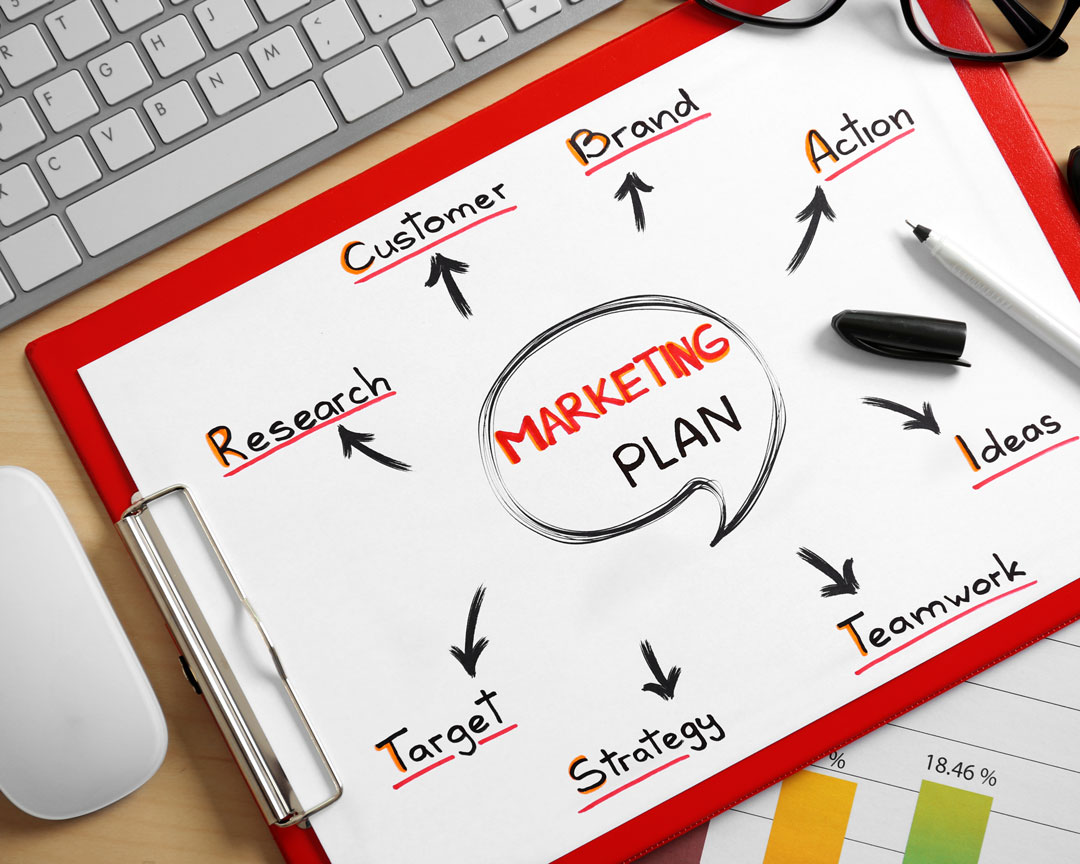
A Simple Strategic Marketing Framework
A practical marketing plan does not need to become a heavy document that sits unread in a folder.
It can begin with clear answers to nine questions:
- Who is our priority customer?
- What problem are they trying to solve?
- What outcome do they want?
- How do we help?
- Why should they trust us?
- What should they do next?
- Where will we reach them?
- How will we continue the relationship?
- What result will we measure?
If those questions cannot be answered clearly, producing more marketing material is unlikely to fix the problem. It will simply spread the confusion further.
Stop Marketing at Random
Random marketing rarely fails because every individual idea is bad. It fails because the ideas are not connected to a clear customer, problem or plan.
Before commissioning the next brochure, campaign or set of promotional products, take a step back and decide who you most want to reach, what they are trying to fix or achieve and how your business helps them move forward.
From there, the message becomes clearer, the right channels become easier to choose and every marketing piece has a proper role to play.
That is what turns a collection of marketing activities into a system that builds trust, supports sales and gives the business a much better chance of being remembered for the right reasons.