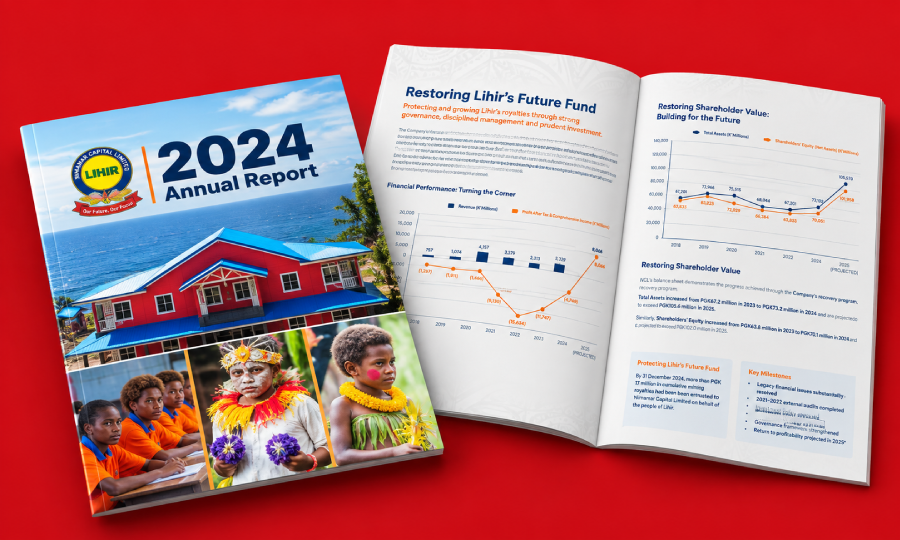
For a long time, annual reports were treated as something an organisation simply had to produce.
Get the numbers in. Include the chairman’s message. Add the statutory information. Send it to print. Tick the box.
Job done.
But that is changing.
Today, a strong annual report has a much bigger role to play. It still needs to meet its compliance requirements, of course, but it can also tell the story of the organisation, build stakeholder confidence and show the progress being made behind the numbers.
In other words, it has moved from being a record of the past to becoming a communication tool for the future.
The numbers still matter, but they are not the whole story
Financial performance is obviously important.
Stakeholders want to know how the organisation performed, where money was spent and what changed over the year.
But financial statements alone rarely explain the full picture.
What were the big achievements?
What challenges did the organisation face?
What changed for employees, communities or customers?
What investments were made?
What is the organisation doing next?
That context helps readers understand what the numbers actually mean.
A good annual report connects financial information to the wider story of the organisation.
Different people are reading it for different reasons
One of the biggest changes in annual reporting is the audience.
It is no longer just accountants, boards and regulators reading the document.
Depending on the organisation, an annual report might be viewed by employees, government departments, investors, community leaders, customers, suppliers, potential recruits, development partners and industry stakeholders.
They are not all looking for the same information.
An investor may be interested in performance and future direction. A community stakeholder may want to see local impact. A prospective employee might be looking at culture, safety and career opportunities.
The report needs to speak to all of them without becoming a 200-page cure for insomnia.
Storytelling has become more important
When people hear the word “storytelling”, they sometimes imagine lots of fluffy copy and inspirational quotes.
That is not what we mean.
Good annual report storytelling is about giving the facts some context.
Rather than simply saying that an organisation invested in community programmes, show what happened as a result.
Instead of listing a new facility as a milestone, explain why it matters.
Use employee stories, project profiles, photography, statistics and real examples to help people understand what was achieved.
The numbers provide the evidence.
The stories help people remember it.
Design is part of the communication
Annual report design used to be largely about making a lot of information fit neatly onto pages.
Today, the best reports are designed around how people actually read.
Most people will not start on page one and carefully read every word until the back cover. They will skim, jump between sections, look at charts, scan headings and stop when something catches their attention.
That means design has a job to do.
Clear hierarchy, strong photography, infographics, pull-out statistics, charts and well-structured sections can turn a dense document into something much easier to understand.
Good design does not make information less serious.
It makes serious information easier to absorb.
Your annual report says something about your organisation
Whether you intend it to or not, the quality of the report itself creates an impression.
A document with inconsistent fonts, poor photography, cluttered charts and mismatched branding can make an organisation feel less organised than it really is.
A clear, confident and well-presented report sends a different message.
It shows that the organisation cares about detail.
It reflects governance.
It demonstrates professionalism.
And for organisations operating in mining, resources, government, NGOs and large corporate environments, those things matter.
Stakeholders are not only evaluating what you have achieved. They are also forming an opinion about how well the organisation is being run.
Papua New Guinea organisations have a particularly strong story to tell
For organisations operating in Papua New Guinea, annual reports can carry enormous communication value.
Mining, resources, government, NGOs and major corporates often have an impact far beyond their core operations.
There may be employment programmes, community investment, training, infrastructure, local procurement, environmental initiatives, education support and partnerships that deserve to be documented properly.
Too often, some of the most meaningful work is buried in a paragraph near the back of the report.
A strong annual report gives those stories the space they deserve while still maintaining the structure and credibility expected of a formal corporate document.
It can help local communities understand the organisation better while also giving boards, investors and international stakeholders a clearer picture of the work being done.
Visual reporting makes complex information easier
Some information is simply better shown than explained.
A paragraph describing five years of performance may be technically accurate, but a clear chart can communicate the same message in seconds.
The same applies to geographic reach, workforce statistics, community investment, safety results and project milestones.
Good information design is about asking:
Can we make this easier to understand?
Not everything needs an infographic, of course. If every page is full of icons, charts and coloured circles, we have simply invented a different type of clutter.
But where visual communication genuinely makes the information clearer, use it.
Photography matters too
Strong photography can completely change an annual report.
Real photographs of employees, sites, projects and communities make the organisation feel tangible.
They show the people behind the numbers.
For larger organisations, it is worth planning annual report photography throughout the year rather than suddenly realising three weeks before deadline that all you have is a folder full of phone photos and last year’s headshots.
A little planning goes a long way.
Digital has changed the format as well
Annual reports are no longer designed only for the printed page.
They may be downloaded as PDFs, viewed on phones, presented on websites or broken into smaller pieces of content for LinkedIn, internal communications and stakeholder presentations.
That changes how the report should be planned.
A strong annual report can become the source material for months of communication.
Key statistics become social posts.
Project stories become website articles.
Leadership messages become internal communications.
Major achievements can feed into capability statements and presentations.
Suddenly, the annual report is not a document that gets published once and forgotten.
It becomes a content asset.
Compliance and communication can coexist
There is sometimes a fear that making an annual report more engaging will somehow make it less serious.
It does not have to.
The formal information can remain accurate, structured and compliant while the broader report becomes easier to read and more useful to stakeholders.
The best reports do both.
They satisfy the obligations.
And they communicate.
Start with the story, not the page count
Before designing an annual report, it helps to step back and ask:
What do we want people to understand about this organisation after reading it?
What changed this year?
What are we proud of?
Where have we made progress?
What evidence supports that?
What do stakeholders need to know?
Once those questions are clear, the structure becomes much easier.
Otherwise, annual reports have a habit of turning into a collection of departments sending through whatever they produced last year with slightly different numbers.
We have all seen that report.
An annual report should earn the attention it asks for
Producing an annual report takes a lot of work.
There are financial teams, executives, boards, writers, designers, photographers and printers involved.
If you are going to put that much effort into it, the finished document should do more than satisfy an obligation.
It should help people understand the organisation.
It should reinforce confidence.
And it should tell the story of what happened, why it mattered and where the organisation is going next.
That is the real evolution of the annual report.
From compliance document to communication tool.
Planning your next annual report?
Brand Hero PNG helps organisations across Papua New Guinea create annual reports that are clear, well structured and professionally presented.
We can assist with report design, information hierarchy, infographics, photography direction, artwork, print production and digital versions so the final document works for both formal reporting and stakeholder communication.
Because an annual report should not just record the year.
It should help people understand it.