Brand Hero PNG is lucky enough to work with some of Papua New Guinea’s big players in mining and resources. Over the years, that has taken us onto some incredible sites.
It is a good change of pace from office life. You swap the desk for high-vis, put on a hard hat and step into a completely different world for a little while.
And there is a lot going on.
Heavy vehicles. Moving machinery. Restricted areas. Dust. Rain. Noise. Contractors. Deliveries. Site inductions. Safety procedures. Compliance requirements. The odd access road that has seen better days. You name it.
We are usually there to consult on site and safety signage, and one thing becomes obvious very quickly: mining and industrial sites in PNG do not have time for vague signage.
There is too much happening.
And the stakes are too high.
In that environment, signage is not decoration. It is communication under pressure.
Good signage helps people make fast, safe decisions. It tells them where to go, what to avoid, what to wear, who is allowed where and what to do if something goes wrong.
Bad signage gets missed, misread, ignored or damaged. Worse, it creates confusion exactly when clarity matters most.
So, what do mining and industrial sites actually require from signage?
1. Clear safety communication
The first job of site signage is simple: keep people safe.
Signs need to communicate hazards, rules and emergency information quickly. No overcomplicated wording. No tiny text. No clever design tricks that look nice in a boardroom but fall apart beside a muddy access road after a week of rain.
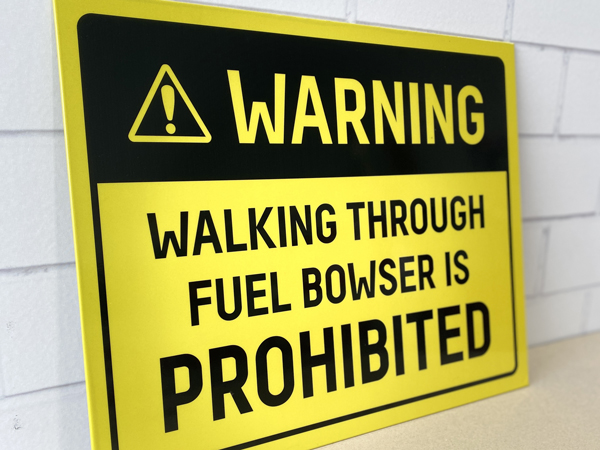
On mining and industrial sites, this can include PPE requirements, danger and warning signs, restricted access signs, traffic and speed signs, emergency assembly points, fire equipment signs, plant and machinery warnings, confined space signage, electrical hazard signage and visitor instructions.
The aim is not just to tick a compliance box.
It is to make sure someone understands the message fast, even if they are tired, new to site, sitting in a vehicle, working around noise or trying to read through rain, dust or glare.
A good safety sign should not need a second explanation.
2. Compliance with site and industry requirements
Mining and industrial signage often needs to meet more than one set of expectations.
There may be site safety requirements, contractor rules, mine site specifications, company policies, traffic management plans, emergency procedures, occupational health and safety obligations and client branding standards.
Fun little paperwork party, really.
That is why generic signs do not always cut it.
A good signage provider needs to understand the context before anything goes into production.
What is the site? Who is using it? What risks are present? Which standards or site rules apply? Where will the sign go? Does it need to be reflective?
Compliance starts with asking better questions.
Not wildly exciting, we know. But neither is replacing a full run of signs because someone guessed the layout.
3. Durability in PNG conditions
Mining and industrial signs have a rough life.
In PNG, they can be exposed to heat, UV, heavy rain, humidity, mud, dust, salt air in coastal areas, chemicals, vibration, vehicle spray and the occasional bump from equipment that definitely “wasn’t that close.”
So the materials matter.
Site signage may require UV-stable inks, protective laminates, aluminium composite panels, reflective vinyl, corrosion-resistant fixings, heavy-duty posts, high-visibility colours and weather-resistant materials.
This is where cheap signage gets expensive.
A sign that looks good on day one but fades, cracks, peels or corrodes within months is not doing its job. It also creates more work for the site team, because someone has to organise the replacement.
If the sign has to survive real site conditions, it needs to be built for real site conditions.
4. Visibility from the right distance
A sign is only useful if people can see it in time.
On mining and industrial sites, signs may need to be read by people walking, driving light vehicles, operating machinery or approaching from a distance. That changes everything.
Text size, colour contrast, placement and reflectivity all matter.
A pedestrian gate sign does not need to work the same way as a speed sign on a haul road. A warning sign near machinery needs to be seen before someone enters the risk zone. An emergency sign needs to stand out instantly, not politely blend into the background.
Good signage considers viewing distance, vehicle speed, lighting conditions, dust, glare, rain, background clutter, height, angle and day or night visibility.
Because the proof always looks neat on screen.
The site is where the sign has to earn its keep.
5. Consistency across the site
Industrial sites can become messy quickly if every department orders signs from a different place.
Different fonts. Different colours. Different sizes. Different wording. Same hazard, five different signs.
Not ideal.
Consistency helps people recognise messages faster. It also helps the whole site feel more organised and easier to navigate.
When danger signs look like danger signs, mandatory PPE signs look like mandatory PPE signs and emergency information is always presented clearly, people do not have to decode the message.
They just understand it.
That is the whole point.
Good signage says: this place is organised, this place takes safety seriously and this place knows what it is doing.
6. Practical wayfinding
Mining and industrial sites are often large, spread out and constantly changing.
Deliveries, contractors, visitors, maintenance crews and emergency responders all rely on clear wayfinding. If someone takes the wrong road, misses the induction office or ends up near a restricted zone, that is not just inconvenient. It can create a genuine safety issue.
Wayfinding signage may include site entry signs, reception and induction signs, directional signs, department markers, loading area signs, contractor parking signs, pedestrian routes, emergency assembly point signs and traffic flow signs.
Nothing says “welcome to site” quite like driving around aimlessly while four utes appear behind you.
A clear sign at the right point saves everyone the trouble.
7. Branding that supports safety
Branding still matters on mining and industrial sites.
Entry signs, office signs, fleet graphics, machinery signage, building identification and directional signage all shape how people perceive the business. A well-signed site feels controlled, professional and credible.
But safety signage is not the place to get overly creative.
The brand should support clarity, not compete with it.
Use brand colours where appropriate. Keep layouts neat. Make the site look professional. But when a sign needs to warn, instruct or direct, the message comes first.
Safety signage has a job to do.
Let it do the job.
The real job of mining and industrial signage
Mining and industrial signage needs to be clear, compliant, durable and practical.
It has to survive tough conditions, be seen from the right distance, guide people through complex environments and communicate important information quickly.
Good signage does not just make a site look organised.
It helps a site work better.
It keeps people moving in the right direction. It supports safety systems. It reduces confusion. It builds confidence for workers, contractors and visitors.
And when it is done properly, it becomes part of the way the site operates, not an afterthought bolted to a fence.
Need to tighten up your site signage? Start with the essentials: clear safety messages, compliant layouts, durable materials and a practical site audit that shows where people need information most.